2008
Case
The hamster has a large facial tumour
Dr Sing Kong Yuen, BVMS (Glasgow), MRCVS
Case study written in 2 Sep 2008
Updated:
04 December, 2012
2012
Case
The hamster has a large facial swelling
Dr Sing Kong Yuen, BVMS (Glasgow), MRCVS
Case study written in
04 December, 2012
In 2008, more Singaporeans keep hamsters but they
are mostly dwarf hamsters nowadays.
In 2008, a mother and daughter surfed the
internet. "There seems to be a case similar to
ours," the mother informed me of my hamster case
in 2002. "Only that in that case, the hamster
dies." Well, I could not remember what happened to
that hamster with the large facial tumour.
Did the hamster die on the operating table? I went
back to review the case. The hamster indeed had a
similar facial tumour to the left side as in this
2008 hamster case!
This 2008 hamster has a
"similar" facial tumour and the owners consulted
me. "But our hamster is only one year old and is
healthy," the mother and daughter must have done
their hamster tumour research thoroughly. The
younger the hamster, the better the chance of
survival on the operating table.
Should the veterinarian
operate or not? Will this hamster survive the
general anaesthesia? Will the tumour recur?
The mother remarked, "Such a large tumour. There
must be a large blood vessel supplying nutrients
to it. To enable this tumour to grow so big!"
"Yes, " I said. You are correct." In this case,
the removal of the tumour is an easy job. The
problem is to stop the bleeding as the big blood
vessels feeding the tumour is cut. Unlike a dog, I
cannot see the large vessel, separate it and
ligate it before cutting off the tumour.
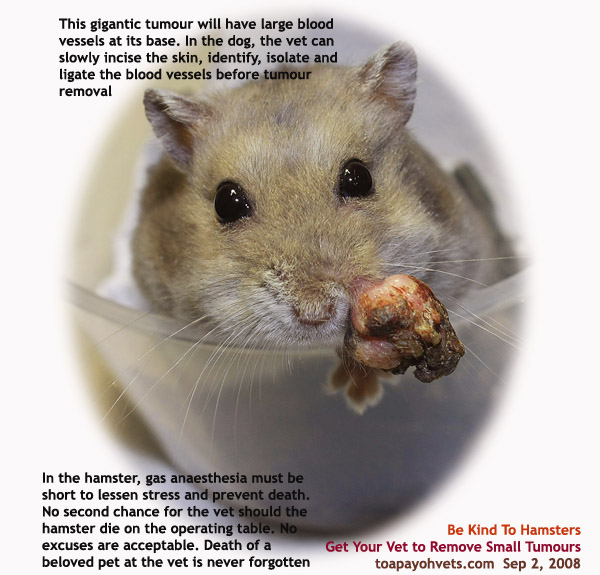
There is just a 3 mm stalk of this tumour
connecting it to the face. A small stalk with big
blood vessels supplying the tumour such that it
grows to be gigantic. A malignant tumour that
keeps growing. If this bleeding is not controlled,
the hamster's mouth and lower neck will be full of
bright red blood.
The hamster was put under
general anaesthesia gas for a few seconds. His big
black eyes closed sleepily. He was taken out of
the gas container. His tumour was snipped off at
the base. Bright red blood shot out as if a dam
had burst.
I pressed cotton swabs onto this small wound of
around 3 mm after removal of the tumour. But the
blood would not stop flowing. The blood spilled
over the lower lips to the neck and shoulders.
What to do now? Obviously the owners can't
be expected to keep pressing the wound to stop the
bleeding. The hamster started to groom himself. To
wipe away the bleeding. To prevent me from doing
it. He was awake now and just would not tolerate
foreign interference.
A more detailed report follows:
Blood
just can't stop flowing
Case of the hamster with a gigantic facial tumour
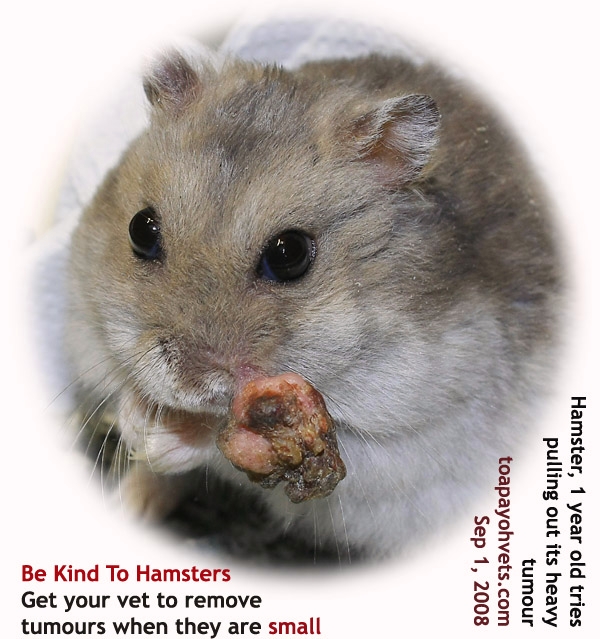
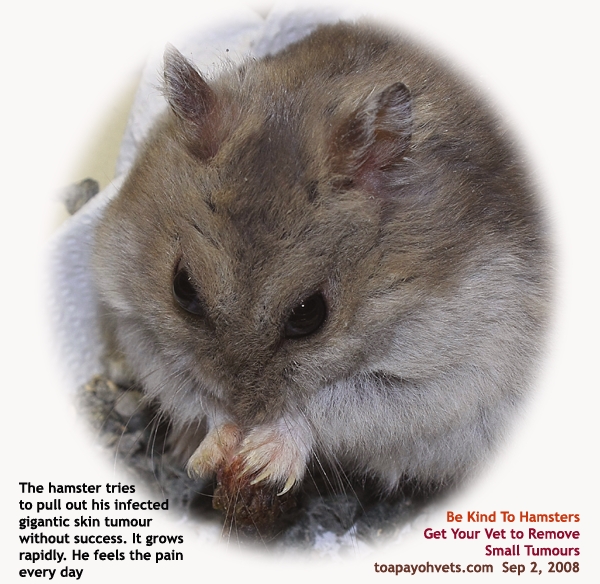
Big black
eyes. He keeps trying to pull his gigantic tumour
every moment when he is not running around or
stuffing his cheek pouch with more seeds. This
tumour just will not fall away. Horrors! It keeps
growing to 10 times the size of his paw.
He is one year old. In the prime of his life. Life
is so wonderful. He eats well and his beautiful
grey and white coat and chubby body reflect his
good life. His tumour has various side lobes, as
if it is a wart. Friction on the floor and from
his rubbing. The tumour starts to get ulcerated
and bacteria starts to grow inside. He is still
able to fight off the bacteria. But for how long?
His owners decides to get him treated at a
veterinarian.
I thought of
cutting off the tumour myself," the mother or the
daughter commented. "It is not advisable," I
mumbled.
"There must be a big blood vessel supplying this
tumour of around 1 cm x 0.5 cm hanging loose from
the hamster's left lip corner," the mother in her
late forties said. "Otherwise, how can this
tumour grow so big." Sounds logical.
This lady must have some medical and surgical
anatomical knowledge of tumours. She or her adult
daughter or both may even be a human doctors. I do
not ask as I am focusing on how to remove this
problematic tumour without losing the hamster due
to bleeding to death.
There will be a lot of bleeding if I cut off the
tumour. No doubt about it. I will have to
severe a large blood vessel when I snip off the
large tumour. Now, in the dog, there is plenty of
time and skin to identify, isolate and ligate the
large blood vessel before I remove the tumour. I
can even see the abnormal blood vessels
commandeered by this hungry tumour. I recall this
canine case --- an old dog with a gigantic breast
tumour. There was a gigantic blood vessel pipe
supplying the breast tumour --- see pictures at
The Buddhist Singapore Tzu Chi Foundation
volunteers saved an old dog from death by
infections.
But this Winter White dwarf hamster is so small.
It is not so easy to identify, isolate and ligate
the equivalent blood vessel due to the much
smaller size of the hamster. But the blood supply
to this hamster's tumour will be large. It will be
bloody and hellish once the tumour is cut.
Under general anaesthesia, the normal dog sleeps
and it is so easy to operate for more than 30
minutes. For this normal and slightly overweight
hamster, general anaesthesia must be very short. A
few seconds, not 30 minutes, so as to reduce the
great risk of death under the anaesthesia.
The hamster wakes up and use his front paws to
interfere with any surgical manipulation. He is
given some anaesthesia gas to continue the
surgery. Anaesthesia must be short and cannot be
prolonged or repeated too often. What to do now?
To the reader, this is a simple snip case. Just
cut off the stalk of the tumour.
Not that easy. I put the hamster in a gas chamber.
The hamster falls asleep as isoflurane gas
anaesthesia is breathed in. I take him out on the
operating table.
I pull the tumour up to see normal skin below it.
One snip of the stalk. A sessile tumour. Easy to
remove, no doubt about it.
Bright red blood shoots out like a fountain,
flowing down the mouth and onto the operating
table. The blood just cannot be stopped. An artery
has been cut. The cut skin has a hole of only 3-4
mm. But the blood from inside this wound just does
not stop bleeding. What to do now?
The hamster wakes up. Smells the blood. Uses his
paws to clean himself.
"Put him
back into the gas chamber," I said to my
assistant. "A few seconds of gas". The less
the hamster is restrained between the towels, the
better. The shorter the gas the better for his
survival.
As the hamster half closes his eyes when smelling
the gas, my assistant takes him out of the gas
chamber and puts him onto the table. He was
semi-unconscious but this is much safer. After
all, he just needs one stitch.
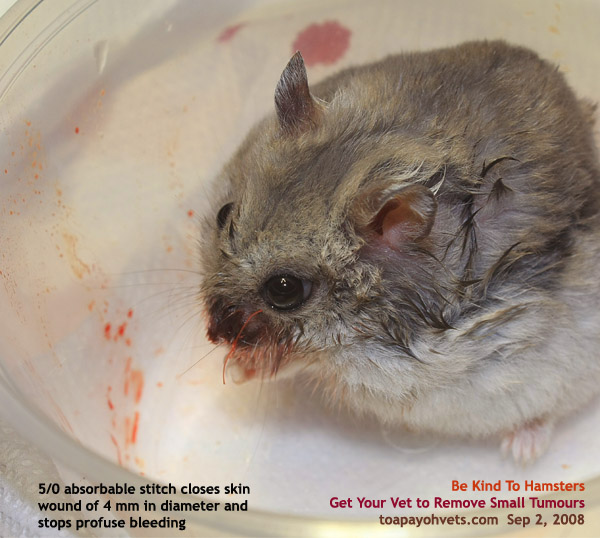
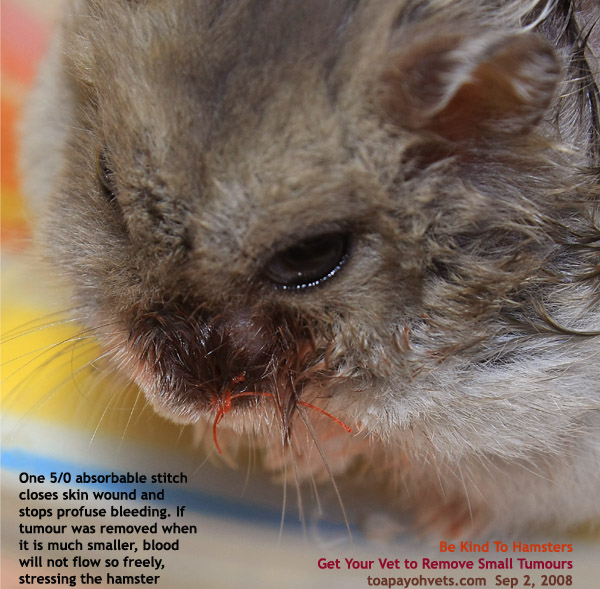
I stitch 5/0 dissolvable suture to close the
wound. One interrupted stitch. The bleeding
stops. The hamster wakes up instantly. He smells
blood. He starts to rub his face vigorously. Blood
just will not stop flowing. What to do now?
I use wet cotton wool to remove the blood now
covering the neck and front shoulders of this
hamster. The hamster looks like he is not going to
make it. He is in shock. The smell of blood. The
smell of isoflurane anaesthesia gas stresses him
and makes him weak. The grip of his shoulders by
my assistant for me to stitch him. His black eyes
bulge out bursting from the eye sockets. Will they
pop out? Anytime, his heart can fail. No
second chance for a vet if a pet dies at the
Surgery. The client will just go to the
competition. Death is not forgotten by the owner.
Death of the beloved pet at the operating table is
not acceptable by most owners and the cause of
death is directed at the surgeon.
If only the owner has had the surgery done when
the tumour was just a 2 mm piece. It will be so
much easier. But back to the reality of life. The
owner expects a live hamster at the end of
the surgery. Otherwise she may as well do it
herself.
Fortunately, the owner has not Do-It-Yourself to
remove the tumour. The bleeding is so profuse such
that the hamster will have died of stress and
haemorrhage. In this case, the stitching stops the
bleeding.
The owners
are very happy to see him without his signature
tumour. I hope he lives a long life. Without
tumours.
BE KIND TO DWARF HAMSTERS.
GET YOUR VET TO REMOVE THEIR SKIN TUMOURS PROMPTLY
---- WHEN THE TUMOURS ARE SMALL!
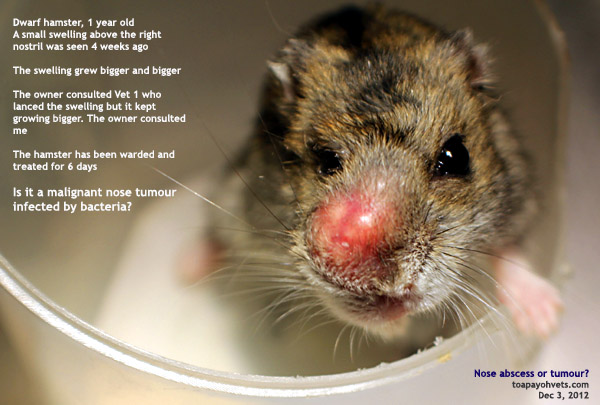
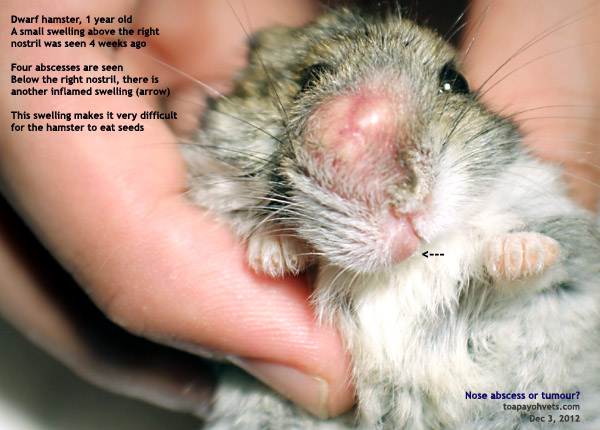
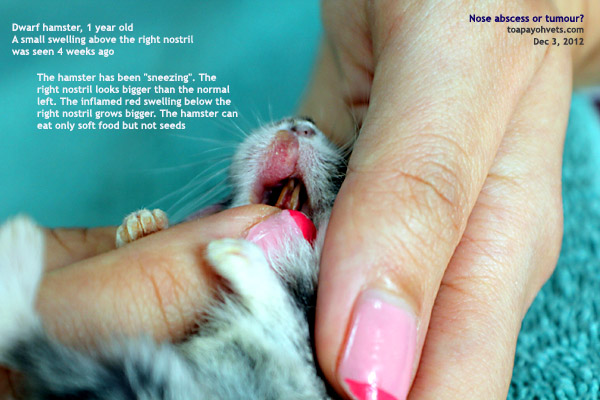
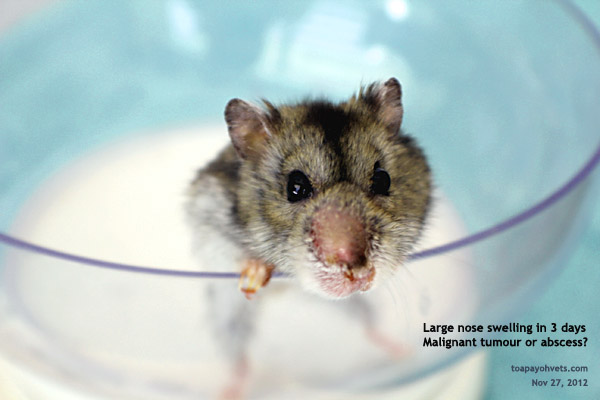
In December 2012, I have 2
cases of large facial
swelling in 2 dwarf
hamsters. One of the cases
is shown below:
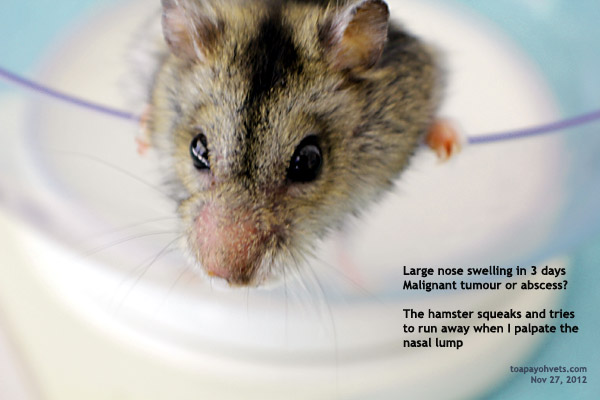
The nose had a small
swelling around 6 weeks ago.
The owner waited and it grew
bigger. After 2 weeks, he
consulted Vet 1 who pricked
one pimple but the nasal
swelling grew bigger.
Medication could not help.
"It could be a tumour," I
said. "It would need to be
cut off but there is a high
risk of anaesthetic death
and infections."
I put the hamster on
medication and observation.
After 6 days, I told the
owner that the facial lump
would be a tumour. "Is it
possible to cut it off?" he
asked. I checked the hamster
again and there were 3
yellow bulging pimples.
"The inflamed hard nasal
lump had softened with time
and medication," I said.
"You did not give Vet 1 time
to get the lump ripened to
become an abscess." The
owner was commenting that
Vet 1 did not do a good job.
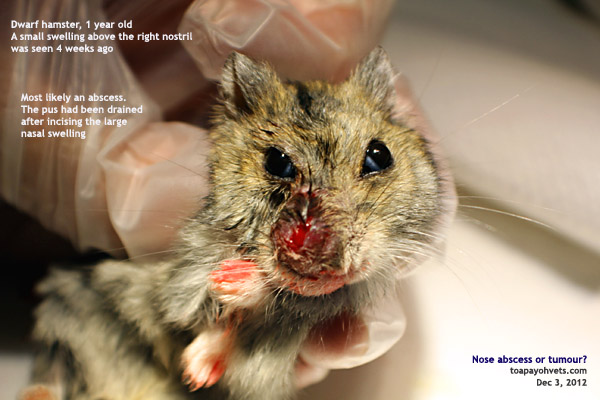
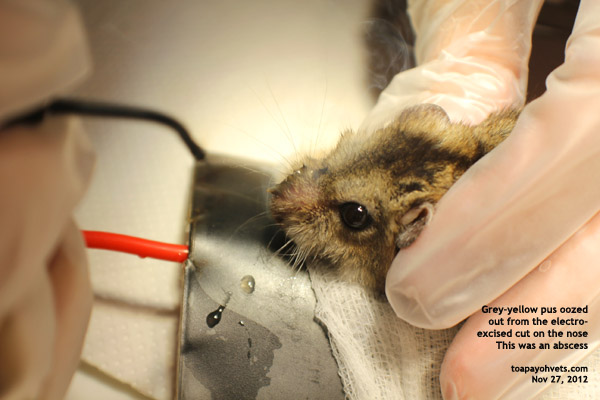
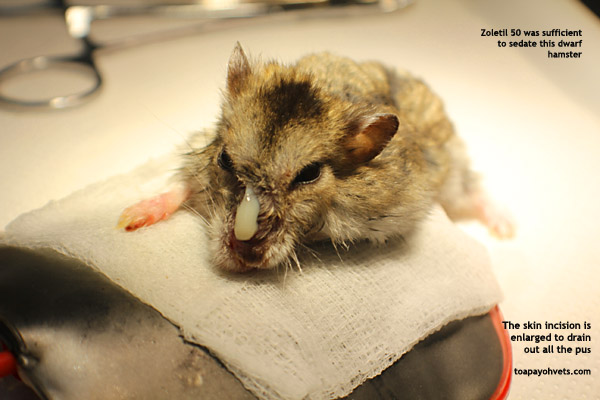
Under isoflurane gas, Dr
Daniel incised the pimples
with a scalpel. Pus oozed
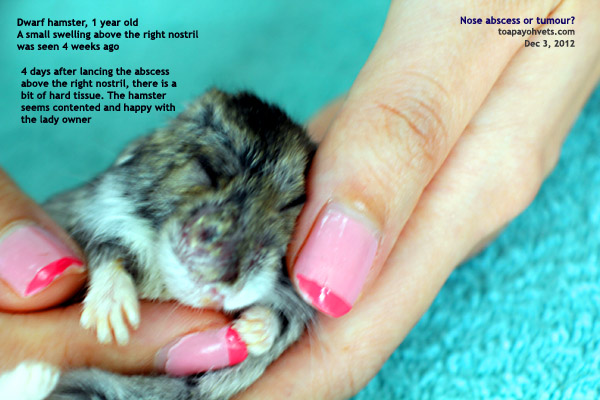
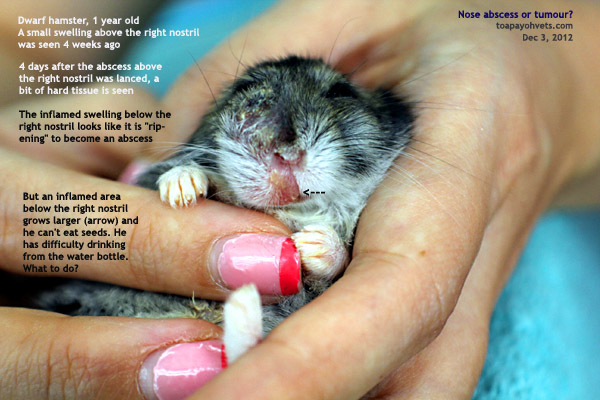
out. 4 days later, the
area was no longer inflamed
and was hardened as you can
see in the images below.
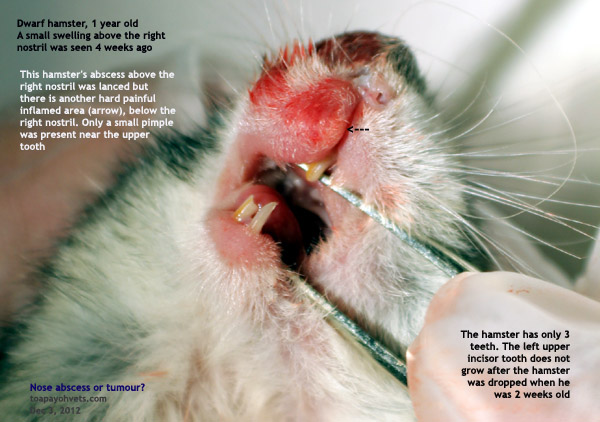
4 days after hospitalisation
and treatment, the pimples
can be seen. Under
anaesthesia, Dr Daniel
lanced the abscess and
drained it.
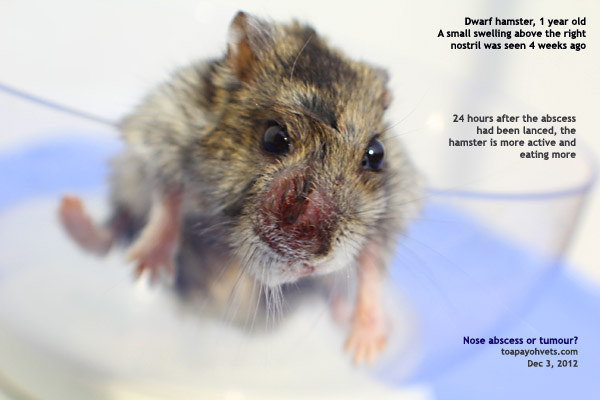
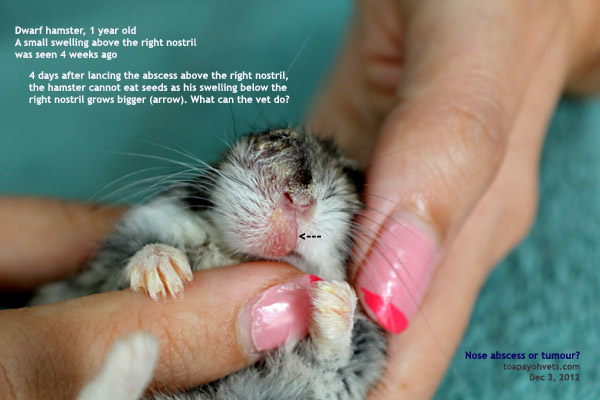
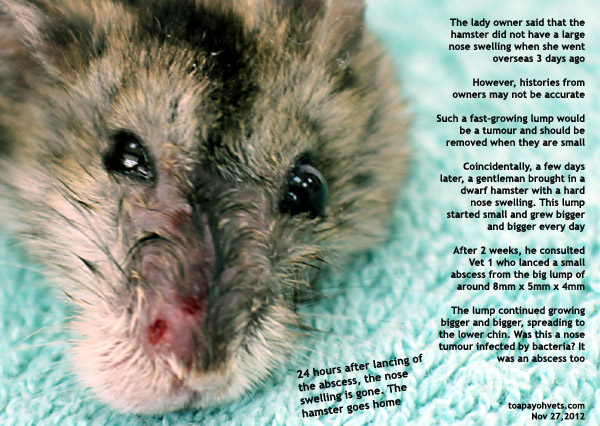
24 hours after lancing the
abscess, no more swelling
Day 4 after lancing the
abscess, a hard lump appear.
It would be granulation
tissue and should disappear
after a few weeks.


 Toa
Payoh Vets
Toa
Payoh Vets