 TOA
PAYOH VETS TOA
PAYOH VETS
toapayohvets.com
Blk 1002, Toa Payoh Lor 8, 01-1477,
Singapore 319074. Tel: +65
6254-3326,
9668-6468,
judy@toapayohvets.com,
99pups@gmail.com
Focus: Small animals -dogs, cats, guinea pigs, hamsters,
pet rats and mice, birds and
turtles
July 30, 2020
|
Toa Payoh Vets Clinical Research
Making veterinary surgery alive
to a veterinary student studying in Australia
using real case studies and pictures
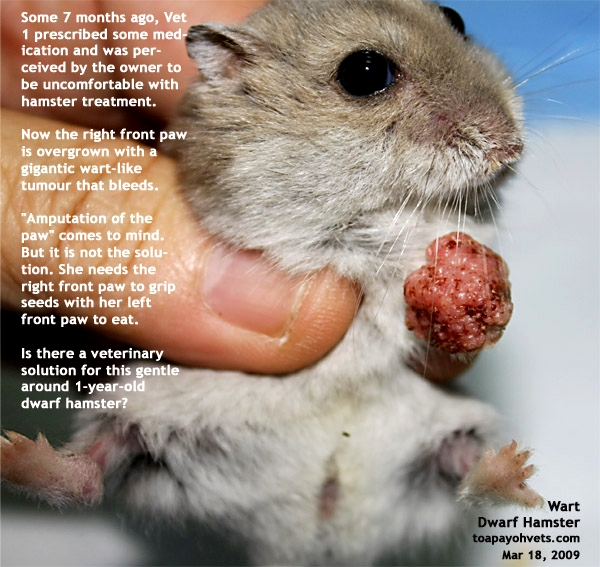
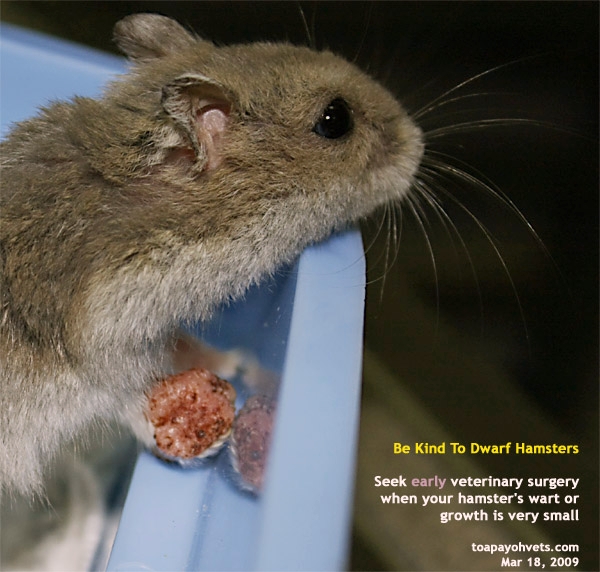
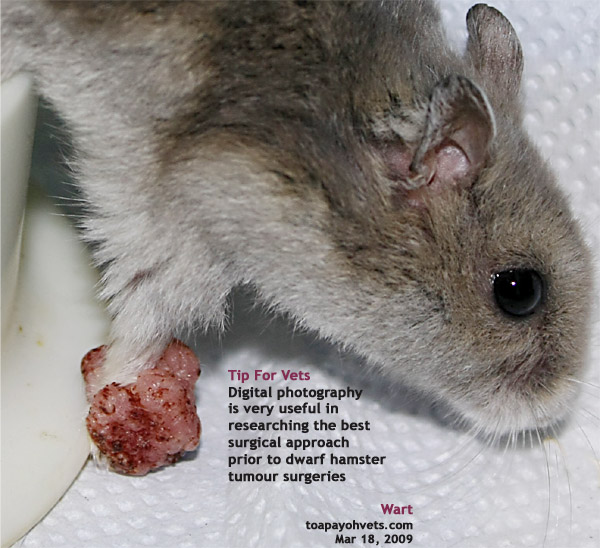
The Hamster Has A "Boxing Glove" Wart
Dr Sing Kong Yuen, BVMS (Glasgow),
MRCVS
Case written: 15 June 2009
Updated:
30 July, 2020
|
|
|
FIRST CRYOSURGERY
IN MARCH 2009 |
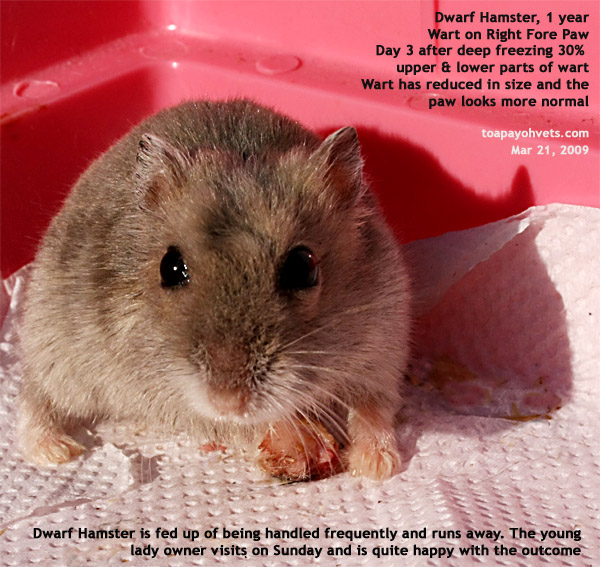
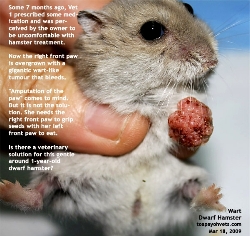
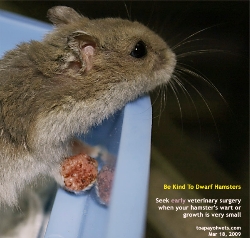
"No paw amputation," the young lady was
adamant during her first consultation with me. Therefore, I
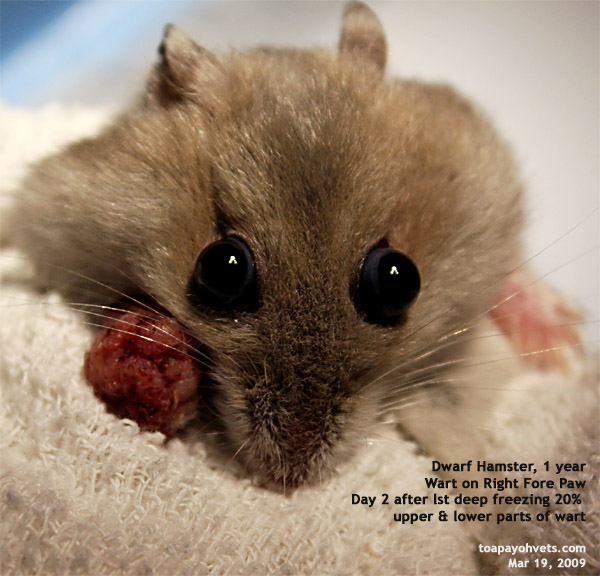
deep-froze the wart partially over 3 days so as not to compromise
the blood supply. This is where the application of anatomy was
practised. Without the knowledge of anatomy, the vet would deep
freeze 100% of the wart at one session, killing off all blood vessel
cells as well as the tumour.
Well, if the wart is as small as 3 mm across, 100% of deep-freezing
in one session does not compromise the blood supply to the paw. But
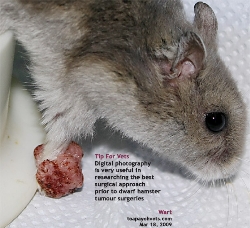
this hamster's wart grew from both sides of the front right paw and
even enveloped below the paw. There was only 3 mm of dorsal part of
the paw that was normal skin. Warts are common in hamsters, the
average Singapore hamster owner is usually reluctant to seek
veterinary treatment due to economics mainly.
In this case, surgical excision by paw amputation will resolve all
problems for the owner. No front right paw means no wart recurrence.
In considering surgery, know the blood supply to the surgical site.
Vet students will find that "anatomy becomes alive" if only the
elderly Anatomy Professor can illustrate with real cases using
videos, instead of droning on with the boring lecture notes on
various branches of the blood supply to the paw, making the students
sleep.I was one who found it
hard to stay awake during my Anatomy lectures at Glasgow University
some 40 years ago. There was no internet to view cases. The Glasgow
Library had books which were dusty and brown and were probably 100
years old. But now, students are so fortunate to live in the Golden
Age of the Internet.
Back from digression, in this hamster, I used cryosurgery.
CRYOSUGERY is the use of extreme cold to destroy abnormal tissues
such as tumours. I sprayed liquid Nitrogen onto the tumour to freeze
and kill the tumour cells.
I had deep frozen the front paw wart in two sessions so as to
preserve the blood circulation. The cost to the owner was high due
to the need to hospitalise the hamster for more than 14 days to be
given nursing and medication. |
| |
 |
|
|
| |
 |
 |
|
|
 |
 |
|
|
 |
 |
|
|
SECOND CRYOSURGERY
IN JUL 2009 |
|
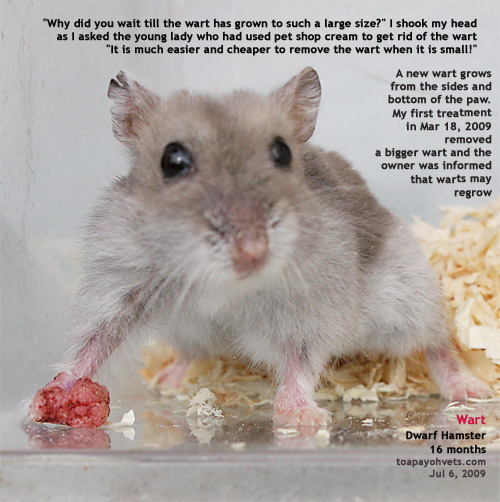
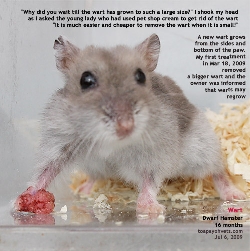
So when the wart re-grew
in less than 2 months, it was understandable that the owner went to
the pet shop to buy a tube of cream. But the wart just exploded and
once again, the hamster looked as if he had put on a boxing glove on
his right fore paw.
For the average owner, $260 that had been paid for the first surgery
and hospitalisation would be a princely sum to spend on treatment of
a hamster. Why? A new hamster costs $5.00 or is free of charge.
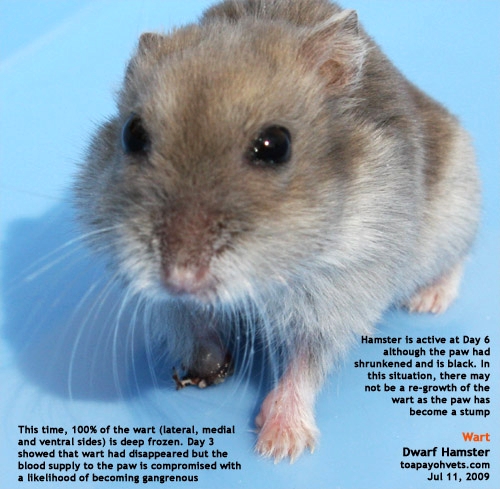
Therefore, in the second
surgery, I deep-frozed 100% of the wart in one session. The wart
disappeared by Day 3. 100%. My assistant was impressed. The paw had
shrunk by over 80% within 3 days. But the blood supply had been
compromised. It had become a black paw with white nails at the end.
Soon it would become a stump. There would be no more normal paw.
However, the hamster was OK, eating and running around in the cage.
It went home soon. There would not be any recurrence as the paw had
shrivelled to a gangrenous hook. It would drop off in a few days'
time. The hamster was active and eating and hence fit to go
home.
The owner asked: "Did you cut off part of his paw?" I pointed to the
black paw with white finger nails, "I did not cut off the paw. Look
at the black foot. Its blood supply had been compromised due to the
100% deep freezing of the "boxing glove' wart. Therefore the paw had
shrunk and appeared cut away!"
In my practice, such gigantic "boxing glove" warts are rare in dwarf
hamsters. Therefore, I am writing this report to share my findings
with the vet students and hope that when they have to study Anatomy
of the Paw, they can relate to this case.
Vet students: Do you know which blood vessels supplying the
paw had been "deep frozen" causing gangrene of the paw? Check
out your anatomy book. Your lecturer may just test you on the blood
supply to the paw during the examination. Be prepared.
|
|
 |
|
|
|
 |
 |
|
|