A veterinary-client relationship of trust and
respect benefits this Great Dane
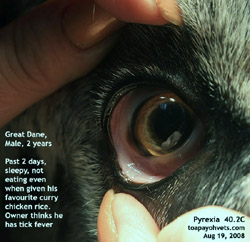 "My Great Dane does not eat even his favourite
curry chicken rice. He is tired and has pale
eyelids for at least 2 days. Is it possible he has
tick fever?" Jenny phoned me. "I removed some
ticks from him recently." "My Great Dane does not eat even his favourite
curry chicken rice. He is tired and has pale
eyelids for at least 2 days. Is it possible he has
tick fever?" Jenny phoned me. "I removed some
ticks from him recently."
She was my ex-veterinary
nurse some 20 years ago and has at least 20 years
of handling dogs and cats in various employment in
boarding, veterinary practice, breeding and retail.
She started work with animals
since she was 18 years old and has hands-on
experiences in dog diseases in Singapore.
Jenny continued: "The Great Dane has no appetite
and sleeps a lot for the past 2 days. He looks
pale in his gums. Can it be tick fever? Can you
make a house-call?" the caregiver asked me.
"Jenny, if you think it is tick fever, bring the
dog to the Surgery. There is no point making a
house-call as it is much easier to treat him in
the Surgery." I advised this busy manager of a
large pet accessory warehouse retail shop in Pasir
Ris.
"Can I come tonight?" the caregiver wanted to
clear her administrative and paper work first.
"If you think he has tick fever,
do not delay treatment," I needed no explanation
that every delay permitted the blood parasites to
multiply and destroy the blood cells.
"I will get a pet transport man to bring the dog
down to the surgery. If it is the starting of tick
fever, come down now to get the dog treated before
the blood parasites multiplying in his red blood
cells overwhelms and kills him," I advised.
Jenny arrived at 3 pm with an assistant. She is a
gentle soft-voiced lady in her forties. I was surprised that her hair
was disheveled while multiple frown lines creased
her face. The 2.5-year-old male giant canine
came down from Jenny's car and sauntered into the
Surgery. He had never been sick and therefore had
not been to the veterinary surgery for the past 2
years. He was as tall as a 12-year-old child.
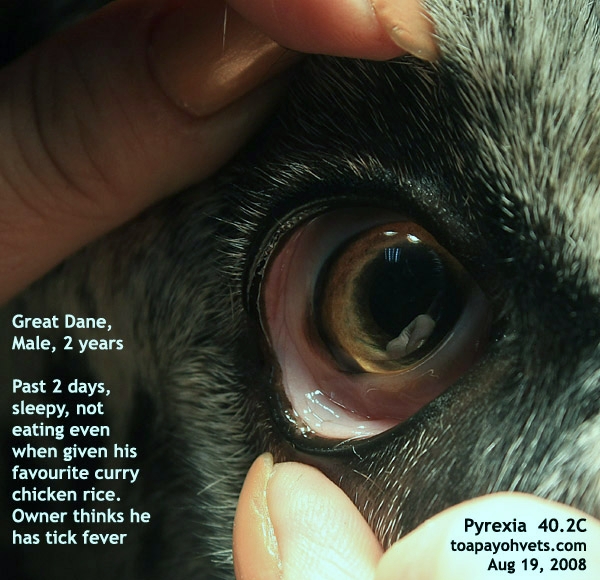
Fever of 40.2C was confirmed by taking the rectal
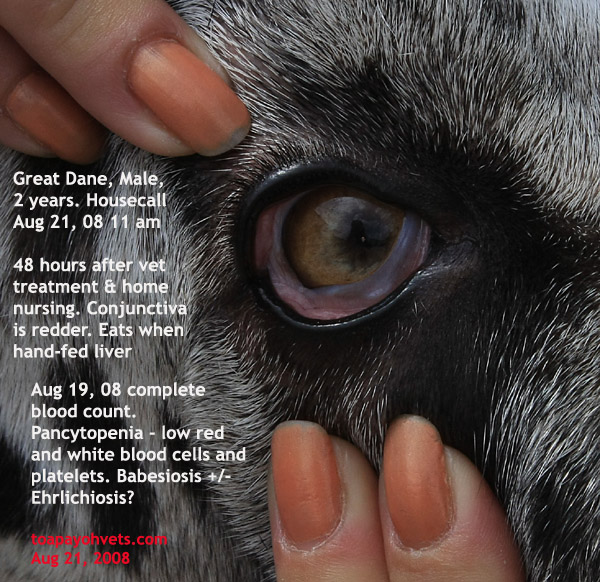
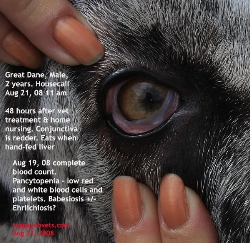
temperature. There was moderate pallor of gums and
conjunctiva.
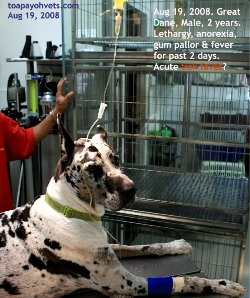
Two men carried the giant onto the table. He
weighed around 80 kg.
 |
 |
|
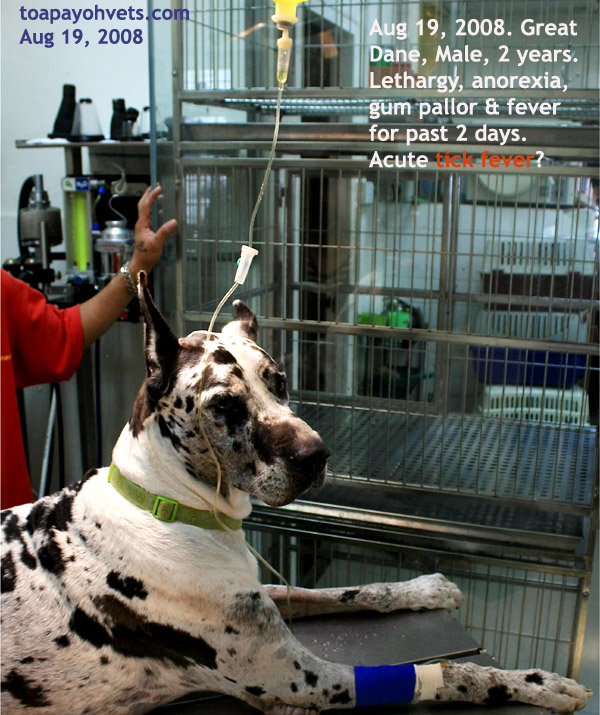
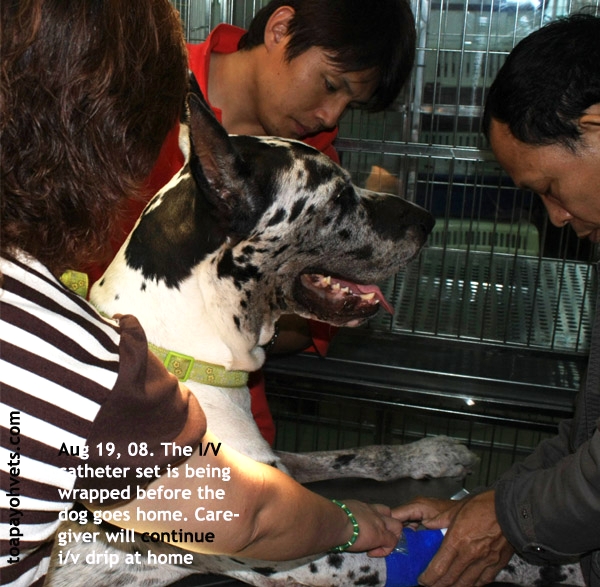
Complete blood count needed. I/V
antibiotics and amino acids given. Sent
home with the i/v catheter in his vein.
|
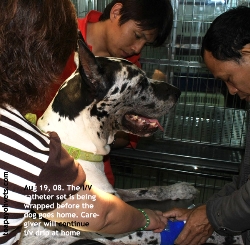
Care-giver
wants the dog home to treat herself |
|
|
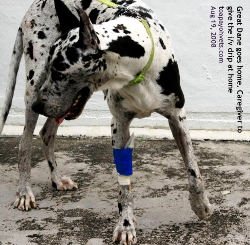 |
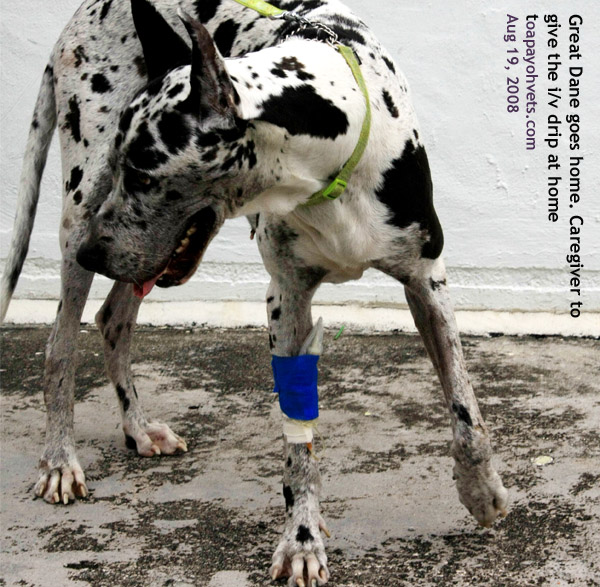
Put catheter IV inserted. 3 blood samples to be
sent to the laboratory. IV dextrose saline,
duphalyte and baytril IV given. Sent home with
bottle of 5% dextrose saline and duphalyte on slow
IV drip. Dog could still walk home. He looked
normal.
Wednesday Aug 20, 2008
Not eating much. Lethargy. No news from caregiver.
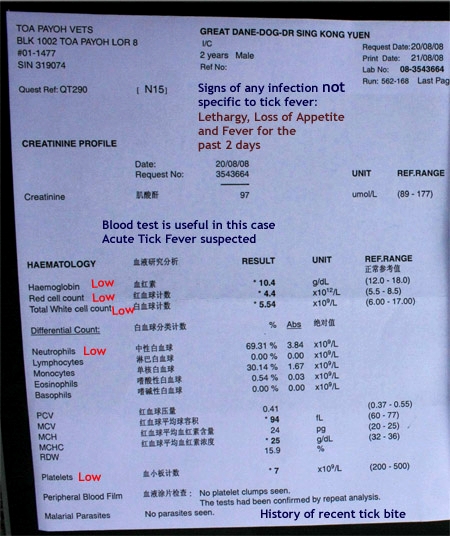
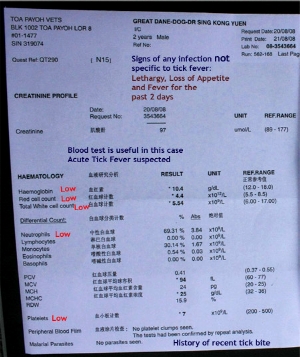
Pancytopenia in blood test result - Low red, white
blood cells and platelets. Based on laboratory
tests, the Great Dane should not be standing and
should be bleeding to death. But he could be at
the start of the acute stage of Tick Fever and the
parasites were just destroying his blood cells.
Was there any hope for him?
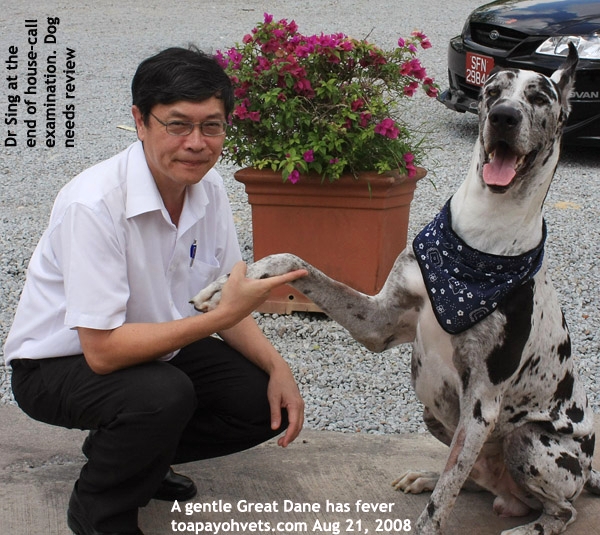
Thursday Aug 21, 2008 house-call by vet
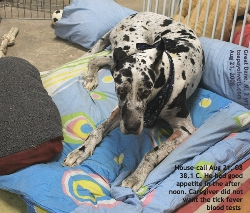
Phoned caregiver. Not really improved. Still not
eating much.
I told caregiver I would need to make a house-call
to check and give
anti-babesiosis injection. What I said was all
Greek to the caregiver.
 |
 |
|
Vet needs to do a house call. The busy
caregiver did not update the vet.
|
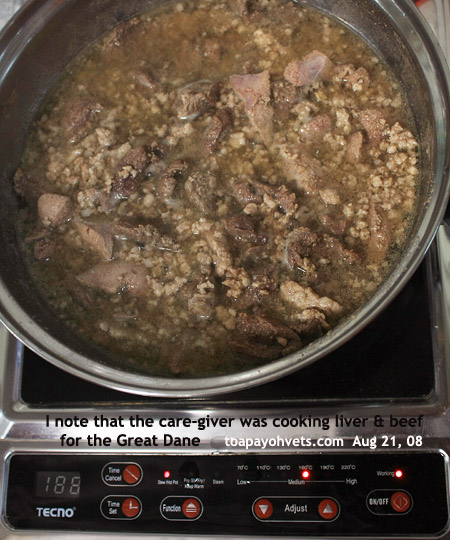
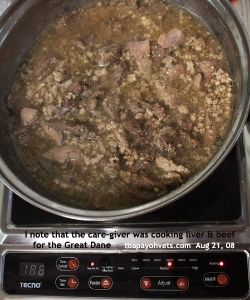
Caregiver cooked liver. She gave a few
bags of fluid and lots of multivitamins to
the Great Dane for the past 2 days.
|
 |
 |
|
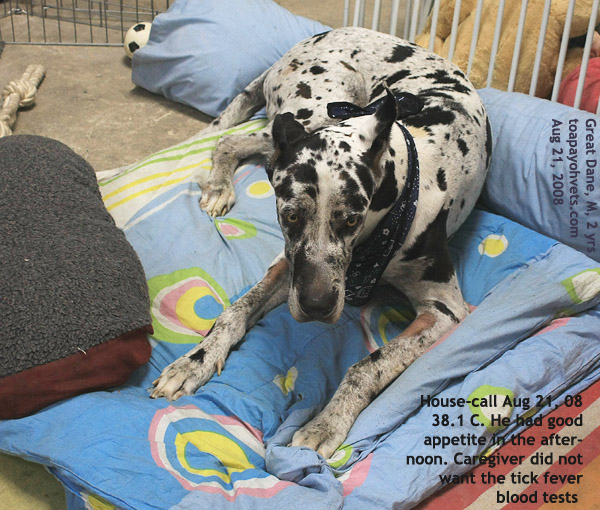
"Dog looks normal," his gentleman owner
said. "No pallor of tick fever." |
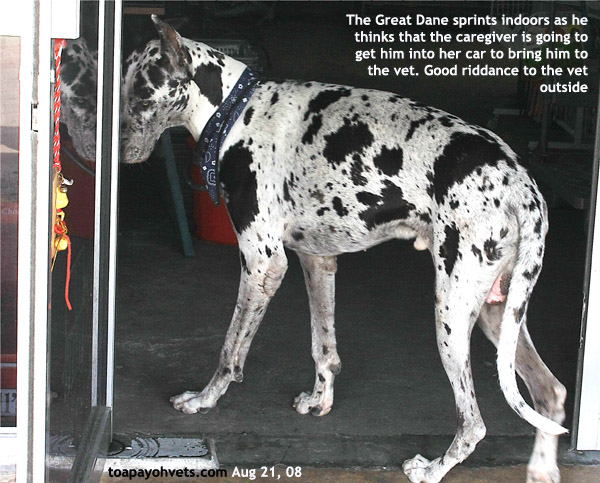
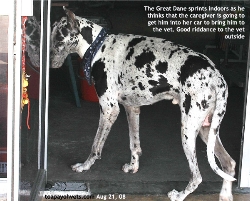
The Great Dane remembered the injections
and drips at the vet and ran into the
safety of his home. |
|
|
|
|
|
|
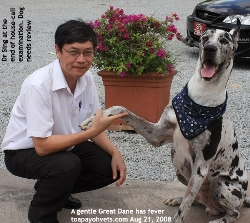 |
The Great Dane reluctantly said goodbye to
me since his caregiver asked him to
do it. Given anti-babesia injection on Aug
21, 2008 before I left the Great Dane's
residence. He had not recovered
fully as at Aug 25, 2008. Jenny was
advised to monitor his rectal temperature.
She needed to buy a thermometer.
|
The caregiver was cooking liver. Dog ate when
caregiver hand-fed bits of liver.
Caregiver showed me that she had bought 0.9%
Sodium Chloride
from a general practitioner and 5% dextrose
bag from somewhere. She would give the solutions
by SC. I gave 2.6 ml Imizole SC. Duphalyte x 1
bottle to caregiver. Advised caregiver to come for
more vibravet medication on completion of 7 days'
course and buy a thermometer.
Friday Aug 22, 2008
Great Dane not really interested in food.
"No time to buy the thermometer," caregiver said.
"Did you check on how much water the Great Dane
drink and what is the colour of his urine?" I
asked.
"You know, I have been very busy updating price
list of goods nowadays," she said. "I also cooked
for the dog. I do not have time to monitor how
much water he drinks or the colour of his pee!"
The cost of goods must increase as there was a
surge in food, petrol and other prices in the past
week and the caregiver was responsible to get the
updates done before the weekend sales. The Great
Dane had to fall sick and took up a lot of her
time.
"Blood tests for Babesia and Ehrlichia at the AVA
would cost $200. Do you want them?" I asked the
caregiver.
She was hesitant about the costs involved. As I
have had given the Great Dane the important
treatment for the two types of parasites causing
tick fever, I said, "Wait and see".
Tuesday Aug 26, 2008
"Great Dane asked to be bathed today,"
Jenny
phoned me. "I need to come down to your
surgery to get the vibravet tablets". Surprisingly
the caregiver remembered as she had a lot of
paperwork to do and I did expect her to forget
about the medication as most owners will do. After
all, the Great Dane is now eating and medication
had been given for 7 days.
"When did the Great Dane recover?" I asked as I
did not pester Jenny since the last call. She said
she had some much paper work to do the last time I
phoned her. Nowadays, a capable and intelligent
hardworking employee does the work of 3 people and
work never ends for the good employee.
Jenny said, "On Sunday, the Great Dane was so
hungry and wolfed down his food."
"It must be due to Imizole and medication," I
forgot to acknowledge caregiver's important role.
"It is due to my extra vitamins and cooking of
liver for him." Jenny replied. Sometimes
veterinarians look at the cause and effect of
drugs rather than the acknowledgement of the care,
time spent and love of the caregiver when the case
is closed successfully.
Her boss came to the surgery to get vibravet for
10 more days as Jenny was busy updating the pricing of
pet products. "Go and buy two thermometers," I
said to the boss. "Jenny has been too busy to buy
one. The thermometers can help to monitor the
fever of your sick dogs." Jenny monitored the
fever by feeling whether the belly of the Great
Dane was hot to the hand or not. That was not a
good way to do it.
Conclusion
It is important for the vet to follow up on
suspicious tick fever cases. As there was a
relationship of trust and respect, I made a
house-call to give the Great Dane the anti-Babesia
injection after reviewing his blood panel tests.
There was no time to wait for the specific blood
tests to confirm the presence of the blood
parasites which may or may not be present.
This caregiver was extremely good in the nursing
care of the Great Dane and a great asset to her
boss. A relationship of trust and respect between
the caregiver and the veterinarian is always
beneficial to the pet. If there was no such
relationship, I doubt I would dare to do the
house-call as a follow up on the first treatment.
UPDATES
This case is probably an acute tick fever.
Although the blood parasites were not isolated nor
was a blood smear done due to financial
considerations,
the blood test of low blood cells and platelets is
suggestive of an acute tick fever. Aggressive
treatment is necessary to prevent recurrence of
fever. No further treatment was requested by the
owner.
 As at Sep 10, 2008, the Great Dane
was
normal. He lived for a few more years and
passed away suddenly around 2010. As at Sep 10, 2008, the Great Dane
was
normal. He lived for a few more years and
passed away suddenly around 2010.
Acute Tick Fever in dogs is hard to diagnose
as there are no specific signs. Lethargy, fever
and loss of appetite may be the only signs. As
these are non-specific symptoms, diagnosis of tick
fever is often missed.
Blood parasites such as Ehrlichia canis
and Babesia canis (protozoa) destroy the white and
red blood
cells respectively.
Haematolgy. Blood tests can be very
useful in aiding the diagnosis of tick fever. In
this case, the Great Dane had very low white cell,
red cell and platelets. Test for Ehrlichia titres
and babesia are available at the AVA (Agri-Food
and Veterinary Authority) laboratory. The cost for
both is around S$200.00. 5 ml blood in plain tubes
is needed. However, the client did not want the
blood tests done.
Subclinical Tick Fever
(no signs) can exist in the dog for years. Then it
becomes Chronic Tick Fever (severe anaemia,
bleeding from nose, kidneys and intestines to
death). Most cases of tick fever are diagnosed at
the chronic stage.
Doxycycline oral tablets and Imizole (imidocarb)
injection are drugs of choice for the treatment of
tick fever. Avoidance of ticks by using
fipronil, permethrin and amitraz are best as there
is no known vaccine available.
In this case, financial considerations prevent me
from following up to check the elimination of the
parasites or any carrier status.
|
 TOA
PAYOH VETS
TOA
PAYOH VETS