TOA
PAYOH VETS TOA
PAYOH VETS
toapayohvets.com
Blk 1002, Toa Payoh Lor 8, 01-1477, Singapore 319074
Tel: 6254-3326, 9668-6469, 9668-6468.
judy@toapayohvets.com
20 May, 2015
Focus: Small animals - dogs, cats, guinea pigs, hamsters, turtles &
rabbits
Injectable Anaesthetic Procedures in
an animal shelter and in Toa Payoh Vets
Dr Sing Kong Yuen, BVMS (Glasgow),
MRCVS
First written: 8 May 2008
Updated:
20 May, 2015
PART I. Sharing Knowledge with
Veterinarians
Anaesthetic Procedures in NANAS
Sunday, Apr 27, 2008
I visited NANAS (Noah's Ark and Natural Animal Sanctuary), an animal
sanctuary in Johor on a fine cloudy humid Saturday afternoon of
April 26, 2008 to know more about animal shelter medicine. I had the
opportunity to study the effects of Zoletil combination being used.
To share knowledge with others working in dog and cat shelter
medicine in other countries via the world wide vet, I have recorded below
the following effective anaesthetic regime in NANAS. It is an alternative
to gas anaesthesia and is less expensive. The dosage is as follows:
1. Zoletil 50 (Virbac) white
powder is present in a bottle.
Tiletamine 125mg, Zolazepam 125 mg. I refer to this as the Zoletil bottle.
2. Xylazine 100mg/ml in a bottle. Put 2 ml of this into the
Zoletil bottle.
3. Ketamine 100mg/ml in a bottle. Put 8 ml of this into the Zoletil
bottle.
4. The bottle now contains a clear solution of 10 ml. This
combination is used as shown below:
FOR CAT SPAYS
1-2 kg. 0.15 - 0.18 ml IM
Bigger cats 0.2 ml IM.
I noted that the duration of
surgical anaesthesia was more than 30 minutes in cats 1-2 kg being
spayed. The tongue is pulled out as a routine to prevent food being
vomited during surgery. Such food gets into the lungs and cause
death by inhalation pneumonia. Surgical incision is midway between
umbilical scar and pelvic brim in the young cats being spayed.
FOR DOG SURGERY
In a dog of around 15kg , a 0.8 ml IM permitted surgical anaesthesia
of around 30 minutes in one case of conjunctival growths being removed. As
the dog showed signs of waking up (eye reflex and mouth clamping), a 0.6
ml IM was injected. The dog was under surgical anaesthesia within 1
minute. Topping up may be required at Animal Shelters.
POST-OPERATION
In NANAS, the following were given for cats and dogs.
1. Tolfedine 4% (tolfenamique 4g) at 0.5 ml IM or SC for cats after spay
and neuter. A pain-killer.
2. Amoxicillin (Longamox) at 0.5 ml SC for cats after spay. An antibiotic.
PART II. Sharing Knowledge
with Veterinarians
Anaesthetic Procedures in TOA PAYOH VETS, SINGAPORE.
Recently, some owners asked me why there were no antibiotics given after
sterilisation of their male cats. Generally, no pain-killers or
antibiotics are given to your male and female cats post-operation from Toa
Payoh Vets for cases operated by Dr Sing as experience indicates that they
are not necessary. Many owners find it hard to give oral medication to
cats.
In big dogs, non-steroidal anti-inflammatory pain-killer and antibiotics
may be prescribed after spay. Typical anaesthetic regimes for
cats living and born in Singapore are shared with fellow
veterinarians by Dr Sing Kong Yuen. Some vets may seek such internet
information. They are as follows as at Feb 1, 2009:
For Dr Sing's cases at Toa Payoh Vets, the anaesthetic regime is usually:
Xylazine & Ketamine injectable anaesthesia are used for cats.
Dosage is xylazine 20 mg/100 ml at 0.2 ml mixed with ketamine 100 mg/ml
0.8 ml in 1 syringe, IM injection. This dosage is most effective for a cat
around 2-4 kg. Onset of anaesthesia is 2 minutes after IM injection
in most cases. Duration of surgical anaesthesia is at least 30 minutes.
For fat cats or young ones less than 2 kg, half the above dose is
sufficient but surgical anaesthesia is less than 10 minutes compared to 30
minutes in above full dose. If necessary, isoflurane anaesthetic gas at 5%
is given by mask for one minute to effect to complete the surgery.
Xylazine & isoflurane gas anaesthesia or gas anaesthesia alone are usually
used for dogs by me as I find them to be most effective. I want the
patient to wake up within 1 minute at the end of surgery. For injectable
anaesthetics, the patient sleeps a long time and this has advantages and
disadvantages. Many owners are happy that their pets are already awake
after surgery.
Please note that the xylazine solution I used is 5X less potent
than that used for the Zoletil combination at NANAS. It is 20
mg/100 ml xylazine, not 100 mg/ml which is the bottle usually used for
horses
Toa Payoh Vets do use Domitor, Antisedan, Zoletil anaesthetic protocols as
well. Experiences are recorded in other webpages.
UPDATE ON MAY 20, 2015. I found that the following formula is effective
and safe:
For a healthy and young dog, 10 kg. Domitor 0.4 ml + Ketamine 0.5 ml
IV in one syringe.
Duration of anaesthesia is around 20 -30 minutes
Onset is 5 minutes.
No need for isoflurane and O2 gas top up if the spay can be completed
within 20 minutes
For old dogs, 50% of dosage with isoflurane gas top up if necessary
For a 16-year-od sick dog, 10% of dosage for short sedation is safe
generally.
INCISION SITE.
In NANAS, I observed that the incision begins at the middle 1/3
area between the umbilical scar and the pelvic brim. Cats I observed were
around 6 months of age. The cat's tongue was pulled out to one side of the
mouth to prevent vomitus from being swallowed. Bladder was expressed so
that the bladder would not be nicked.
At Toa Payoh Vets, I incise at the cranial 1/3 area, at 1 cm from the
umbilical scar in dogs and cats. This position enables me to easily access
and ligate the swollen "on-heat" ovaries easily, especially in dogs.
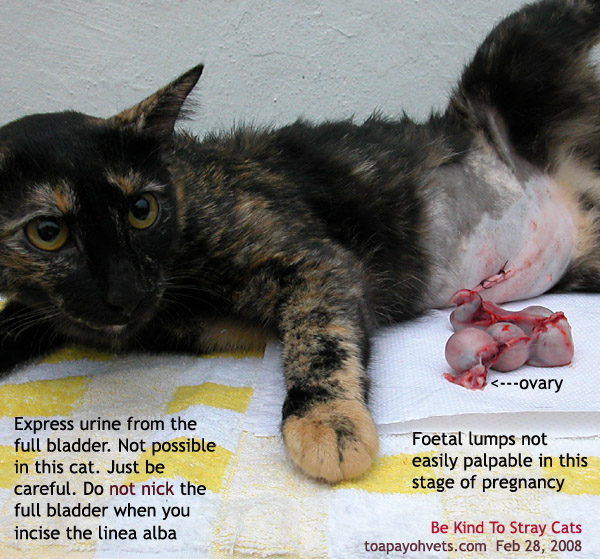
Palpate for the full bladder and express it free from urine before
spaying. Be careful not to nick the full bladder. Seldom do I encounter a
full bladder at this location but there needs to be care in incising the
linear alba in case the bladder is just below. Palpate the abdomen first
to check for the bladder and express the urine.
PART III. Sharing Knowledge
with Veterinarians
Anaesthetic Procedures in one Singapore veterinary practice
I have insufficient
experience with the following anaesthetic regimes but am recording the
procedures based on information provided to me by one vet with
considerable experience in the following anaesthetic protocol without the
need to use gaseous anaesthesia as at Feb 2009.
1. Xylazine 20 & Ketamine 100.
1.1 For example in a Jack Russell, 5 kg dog. 1-5 years old.
Xylazine 20 at 0.4 ml IV, Ketamine 100 at 0.1 ml IV.
Separate syringes. Then top up with Zoletil IM injection if necessary
1.2 For example in a Jack Russell, 6 kg dog. 1-5 years
old.
Xylazine 20 at 0.4 ml IV, Ketamine 100 at 0.2 ml IV.
Separate syringes. Then top up with Zoletil IM injection if necessary
1.3 For example in a Jack Russell, 10 kg dog. 1-5 years
old.
Xylazine 20 at 0.8 ml IV, Ketamine 100 at 0.2 ml IV.
Separate syringes. Then top up with Zoletil IM injection if necessary
1.4 For example in a Jack Russell, 15 kg dog. 1-5 years
old.
Xylazine 20 at 1.3 ml IV, Ketamine 100 at 0.2 ml IV.
Separate syringes. Then top up with Zoletil IM injection if necessary
1.5 For example
in a Jack Russell, 20 kg dog. 1-5 years old.
Xylazine 20 at 1.6 ml IV, Ketamine 100 at 0.4 ml IV.
Separate syringes. Then top up with Zoletil IM injection if necessary
1.6 For example in a Jack Russell, 2.5 kg dog. 10 years
old.
Xylazine 20 at 0.2 ml IV, Ketamine 100 at 0.05 ml IV.
Separate syringes. Then top up with Zoletil IM or IV injection if
necessary
2. TOPPING UP WITH ZOLETIL when the animal shows signs of
movement and recovering from surgical anaesthesia from the
xylazine/ketamine combination.
Zoletil 100 powder. Add 10 ml diluent. The solution is equivalent to
Zoletil 50 now.
Use 0.1ml Zoletil 50 IM for small breeds
Use 0.2 ml Zoletil 50 IM for big breeds (20 kg)
Topping up with Zoletil IM in the above protocols is effective. The above
is useful for vet surgeries without gas anaesthesia or in field work. It
is much more expensive to install gas anaesthesia in certain situations
and I hope the above information will be of use for practitioners.
Obviously, the older dogs and cats will need half the dose and there is a
need to be very careful with injectable anaesthetics. It may be best to
refer to other vets with gas anaesthesia facilities, in the best interest
of the animal.
CASES IN MAY 2009 AT TOA PAYOH VETS
RABBIT INJECTABLE ANAESTHESIA
1.3 kg. Around 4-5 months old. Neuter.
0.1ml Zoletil 50 IM. Wait 5 minutes. Give 0.05ml Domitor IV ear
vein, 27G needle. Effective general anaesthesia. Rabbit takes
>1 hour to wake up. No problem. No need for Antisedan.
CATS INJECTABLE ANAESTHESIA
2 kg. Around 8 months
0.1ml Ketamine 100 and 0.05ml Xylazine 20 IV in one
syringe gave general anaesthesia >60 minutes for spay.
2.5 kg. Around
1 year
0.1ml Ketamine 100 and 0.1ml Xylazine 20 IV in one syringe
gave general anaesthesia >60 minutes for spay. Femoral vein used.
 |
|
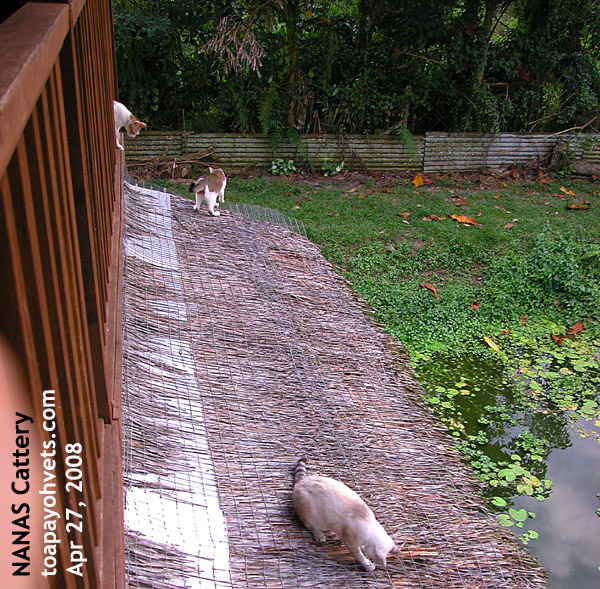
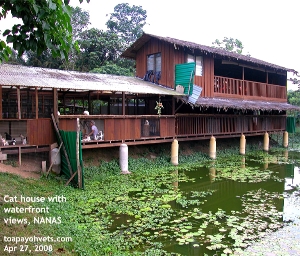
A beautifully designed cat house
in NANAS. Waterfront views and wooden floor boards. |
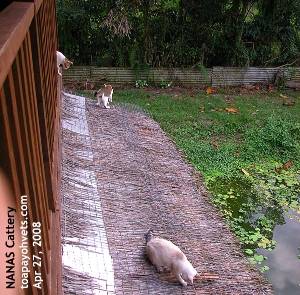 |
| An open area
permitted cats to get out and enjoy the views and sun. |
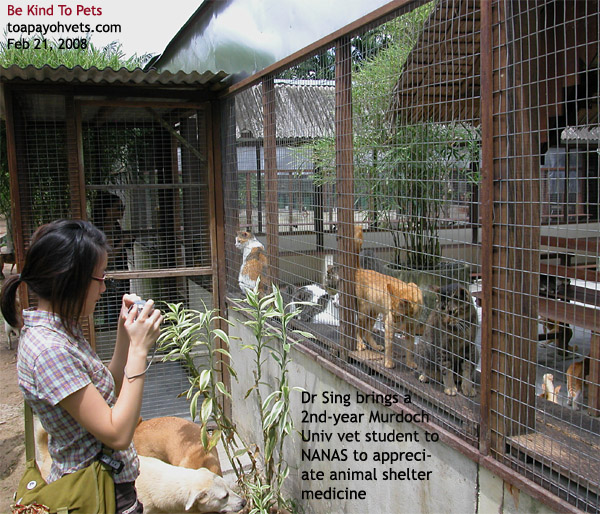
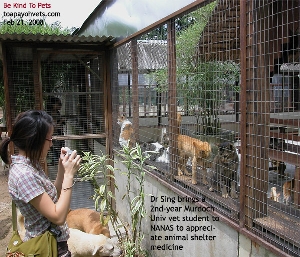 |
| I introduced a
2nd-year Murdoch University vet student who loves cats to visit
NANAS with me so as to expose her to animal shelter medicine. Would
she set up a cats only practice in Singapore? Would such a practice
be feasible? |
PART IV. Sharing Knowledge with
Veterinarians - a Singapore PDSA?
A stray male cat after neuter by Dr Sing in 2003 using xylazine 0.2 ml IM
and gas anaesthesia at that time. Clipped left ear tip in stray cats
indicate they have had been sterilised. But stray dogs do not get such
treatment and it is difficult to know the status of whether the female
stray has been spayed or not.
Despite a first-world country
status, Singapore unfortunately does not have a charitable foundation like
the People's Dispensary for Small Animals (PDSA) in the UK to cater
to the treatment of sick street cats and dogs for owners who can't afford
veterinary treatment.
I saw practice with a private vet in in England in the 1973 during my 4th
year at Glasgow University. He spent 1 day a week at the PDSA to offer his
veterinary services. What stuck in my mind was the arrival of a
driver/owner of a Jaguar car. He brought in a dog for free treatment. One
presumes that the Jaguar car owner does not need the help of the PDSA.
It is hoped that one day, one of our successful entrepreneurs will set up
a Singapore PDSA to help owners who can't afford veterinary attention for
their pets.
SOME CASES OF CAT SPAYS
DONE BY DR SING KONG YUEN |
 |
|
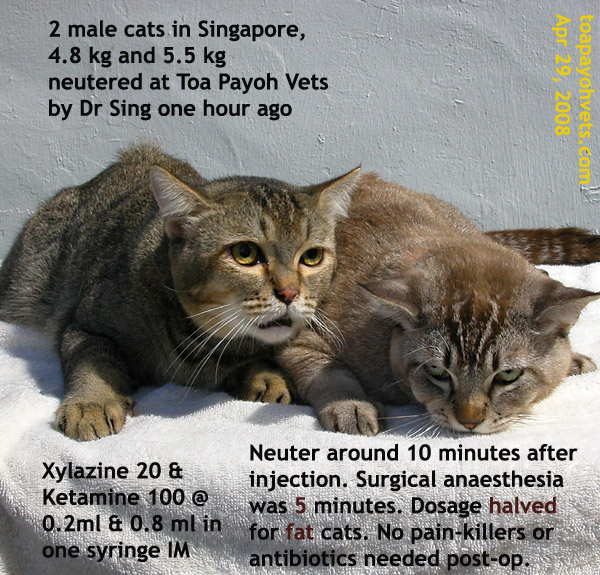
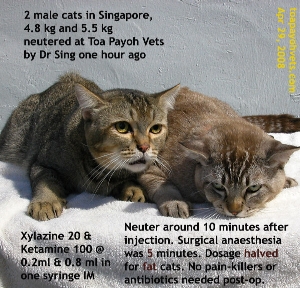
Xylazine: ketamine injectable
combination for the 2 fat cats of around 5 kg neutered by Dr Sing.
Dosage was halved for cats 2-3 kg. Surgical anaesthesia was around 5
minutes as the dosage should be higher. Neutered around 5 minutes
after injection. No topping up was needed in this case. If
necessary, I would use gas anaesthesia for 1 minute. That would be
sufficient to provide surgical anaesthesia. |
 |
|
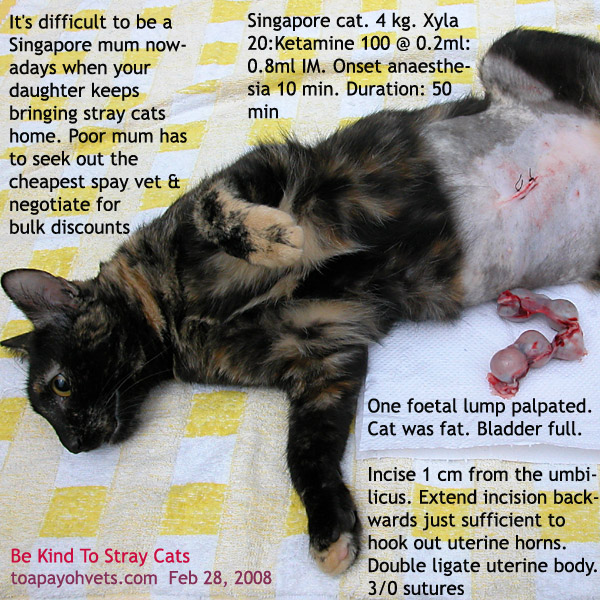
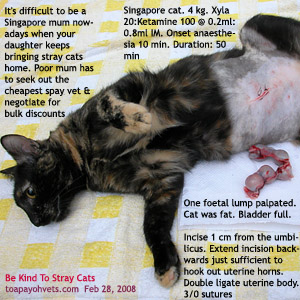
For this pregnant 4-kg cat, the
xylazine: ketamine at 0.2 ml:0.8 ml IM (usually given to cats 2-3
kg) permitted excellent surgical anaesthesia of around 30 minutes
for spaying. |
 |
|
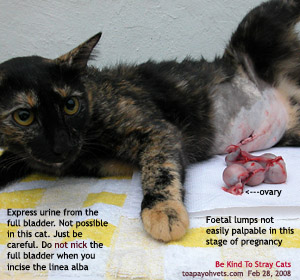
Dr Sing's incision for spaying of
cats is normally 1 cm caudal to the umbilical scar. The
incision length is 1 cm if the cat is not pregnant. In this case, it
is longer as the womb is much larger due to the presence of foetal
lumps. Ligate the uterine body in this pregnant cat two areas
although there should be no slippage of sutures with one ligation.
|
 |
|
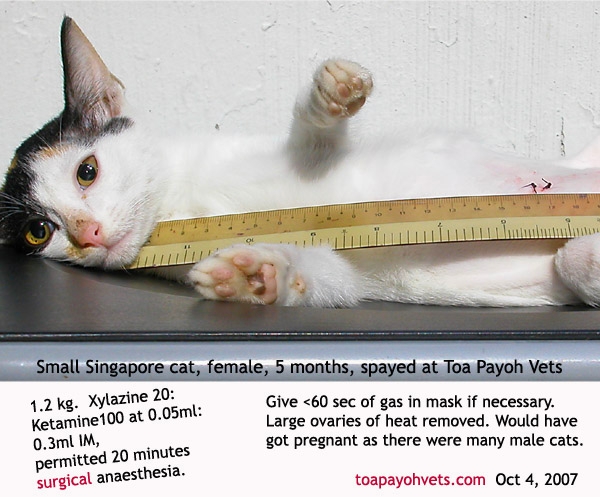
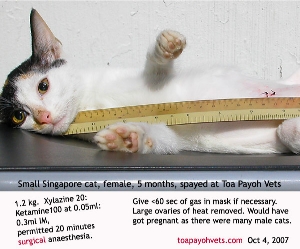
A street cat weighing less than 2
kg. The xylazine: ketamine dosage was less than half of that used
for cats 2-3 kg. The skin incision is around 1 cm. Two horizontal
mattress sutures are usually given. |
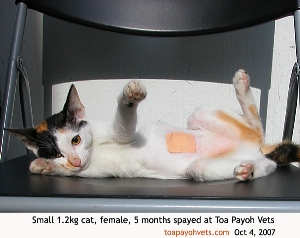 |
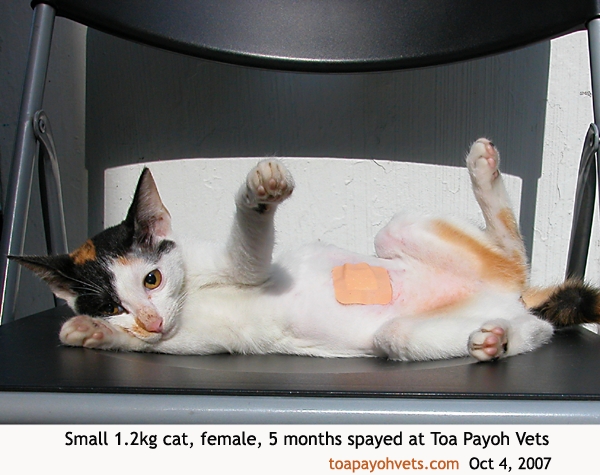
How young should your cat be
spayed? If it is a street cat, animal activists get them spayed
as young as 4 months.
For your pet cat in Singapore, I would advise 6 months so
that her private parts can develop into adult size. If she
caterwauls (meowing loudly non-stop), wait till she stops
caterwauling to get her spayed as it will be bloody doing it during
this stage.
The above cat in Singapore was spayed around 5 months of age
by Dr Sing Kong Yuen. |
1962-67.
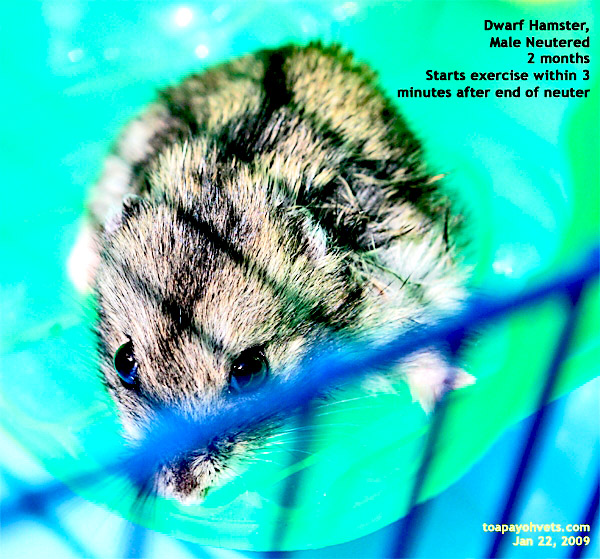
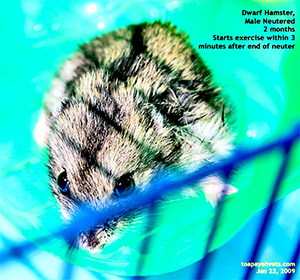
Neutering a 2-month-old hamster at Toa Payoh Vets
FOR MORE CASES AT TOA PAYOH VETS, goto:
Cats or
Dogs
Copyright ©
Asiahomes
All rights reserved. Revised: May 20, 2015
Toa
Payoh Vets |