 TOA
PAYOH VETS
TOA
PAYOH VETS
CALCIUM OXALATE UROLITHIASIS IN A
CHIHUAHUA
The 6-year-old male Chihuahua was in
excellent body condition. Lots of good food
had given him a padded body. He stayed in an
apartment and seldom went down for exercise.
Around the beginning of December, he stayed
with another family member - the brother. At
the brother's apartment, he was shut out of
the bathroom which he normally used as his
toilet as the brother wanted to have a clean
bathroom.
History:
The
brother took the dog outdoors to pee. The
dog took a long time to pee. Sometimes he
took 2 hours to pee. But the dog could not
pee normally in Jan 20, 2009. Urinary
stones blocked the flow of urine as I could
not push the catheter into the bladder
easily. "There is a need to analyse the
urine under the microscope for urinary
stones, cells and infections," I advised the
owner. As the dog could pee, the owner did
not want any tests as that would add to the
costs of veterinary service.
 "If
he can't pee, I will have no choice but put
him to sleep as it is too costly to treat
him," he laughed. I could not persuade him
to take urine tests. Clients have the freedom of
choice but they must be adequately advised
and such advices are best put in writing to
prevent miscommunication and mistrust in a
litigious society - when the dog dies and
family members become very unhappy.
"If
he can't pee, I will have no choice but put
him to sleep as it is too costly to treat
him," he laughed. I could not persuade him
to take urine tests. Clients have the freedom of
choice but they must be adequately advised
and such advices are best put in writing to
prevent miscommunication and mistrust in a
litigious society - when the dog dies and
family members become very unhappy.
"Do not worry, my family will not sue you,"
he laughed when I told him that the problem
of difficulty in urination would recur and
some family members might be unhappy with no
tests being carried out.
Unhappy people see an opportunity to sue the
veterinarian to gain money for "incompetent"
services and negligence and to prevent other
dogs from suffering the same fate of
negligence. In such cases, the vet ought to
give the owner a written statement that he
had had been forewarned about the prognosis.
I did not do it but would record this advice
in my medical records.
On the 10th day after the first consultation
the dog could not pee at all.
"My dog did not really pee normally for the
past 10 days," the slim man in his late 30s
commented. Urine tests and X-rays were
permitted and done.
Surgery on Jan 30, 2009. Two Calcium
Oxalate urinary stones removed from a dark
red bladder with walls as thick as
0.8 - 1.0 cm. Normal bladder walls are
around 0.2 cm. The urinary stones could not
be palpated via the bladder as they were too
small and the inflamed bladder was too
thick. In any case, such a thick bladder
wall would prevent palpation to be done
properly. The dog was hospitalised till Feb
10, 2009 when he could pee normally.
What happened after the dog went home? The
following record is a follow-up as I met the
owner at the Surgery on March 4, 2009.
At home in a high-rise apartment from March
4, 2009
1. "The dog urinated all over the
kitchen floor for the first 4 days at home,"
the owner revealed his observations. "He
drank a lot and peed a lot. I told him to
pee onto the grating (drainage hole cover)
in the kitchen.
"He is an intelligent dog and by the 8th
day, he peed at the grating. He is now back
to normal in peeing."
2. Going outdoors. The owner said,
"I make sure that I bring the dog down to
the grass at least once a day, particularly
in the morning. I want to see that he pees
in a large amount all at once. If the dog is
indoors, he will stand on the kitchen
grate to pee."
3. Urine marking. "Nowadays, after
the surgery, the dog would pee a lot all at
once when brought down. Then he would lift
up his leg to mark but sometimes a small
amount of urine would come out. Other times,
nothing. Prior to surgery, he would pee a
little bit at a time. I had to wait 2 hours
to ensure that he urinates completely. Other
dog owners were puzzled as to why my dog
takes such a long time to pee. Now, there is
no need."
The owner had time as he was self-employed.
I don't really know what he was doing in his
profession. He is a happy-go-lucky man in
his forties, in my observation and sends out
good vibrations.
4. Mum's complaints in the past. "For
some weeks, mum had complained that she
needed to wash the toilet floor many times"
the man said to me in retrospective
analysis. The dog used to stay with the mum
in another apartment and would use the
toilet floor to pee as he had been doing so
for the past 6 years.
Mum would then flush the floor with water as
family members had to use the toilet. But
lately, mum had to do it so many times.
Nobody had thought of bringing this dog for
a veterinary check up. Other dog owners had
also asked the man when he took over the dog
to live with him in December 2008, "Why your
dog takes such a long time to pee?"
"As long as two hours outdoors," the owner
would wait patiently for him to pee all his
urine. This behaviour is not normal but the
owner did not think it was abnormal.
5. Sorrowful demeanour. "I can't
remember why I brought this dog to see you,"
the owner said when I asked why he consulted
me in the first instance. "It must be
because the dog was sorrowful."
10 days before the day of surgery on Jan 10,
2009, the owner consulted me because the dog
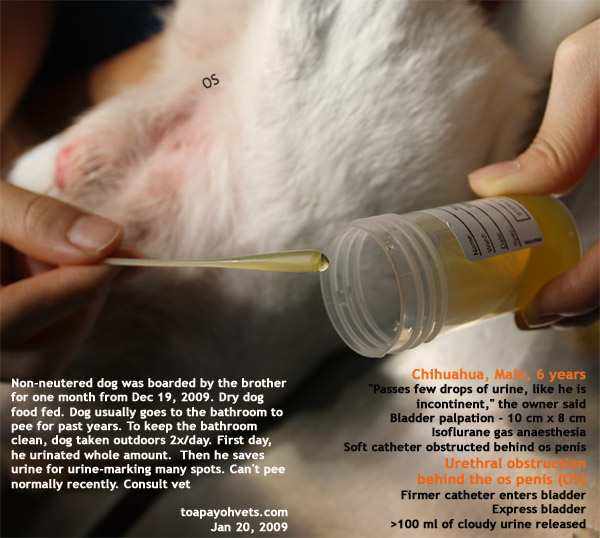
had difficulty in urinating. The urine was
cloudy. The dog seemed to be incontinent,
leaking urine drops onto my consultation
table. The urethra was blocked.
 Catherisation
of the urethra lead to easier urination. The
owner was not keen on X-rays and blood tests
then due to the need to save money. Since
the dog could urinate, he wanted the dog
home. However, I did warn him that there
would be the same dysuria again as the
urethra was obstructed when I passed the
catheter into the urinary bladder with great
difficulty.
Catherisation
of the urethra lead to easier urination. The
owner was not keen on X-rays and blood tests
then due to the need to save money. Since
the dog could urinate, he wanted the dog
home. However, I did warn him that there
would be the same dysuria again as the
urethra was obstructed when I passed the
catheter into the urinary bladder with great
difficulty.
10 days later on Jan 10, he consulted me as
the dog could not urinate. "The dog had
never peed normally since I got him home,"
he said. Catherisation of the blocked
urethra enabled the dog to pass golden
yellow. The smell of urine ammonia was
strong, as if, the toilet bowl's urine was
not flushed for 24 hours.
This time, the owner was agreeable to
urinalysis but no blood tests (complete cell
count, serum chemistry) and X-rays.
Veterinary costs can add up to a large
amount and I understood his financial
concerns. This recession would be the worst
in decades, according to all the experts.
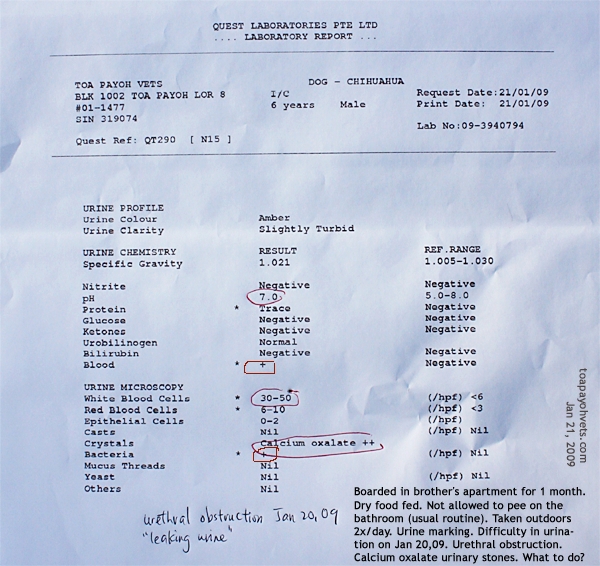
6. Urinalysis. Calcium oxalate
crystals + were the significant finding. See
blood test report above.
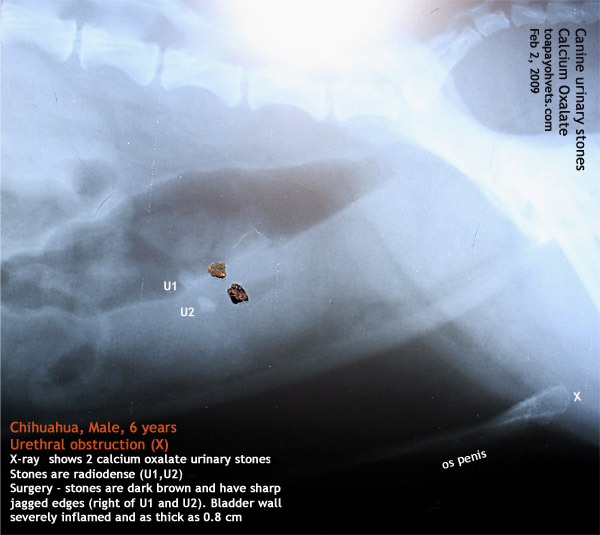 7.
X-Rays. As no big stones were
palpable and the bladder wall was
considerably thickened, it would be wise to
X-ray the bladder to see how many urinary
stones were present. The owner consented.
Calcium oxalate crystals are radio-dense
and 2 were easily seen on the X-ray. If no
X-rays were done, the owner would feel that
the bladder stones were not all removed
should there be a recurrence of difficulty
in peeing. Therefore, X-rays are advisable
except in certain cases where the urinary
stones were so large that they were
palpable. This is because the owner may want
to reduce veterinary costs. Every test add
up to the high costs.
7.
X-Rays. As no big stones were
palpable and the bladder wall was
considerably thickened, it would be wise to
X-ray the bladder to see how many urinary
stones were present. The owner consented.
Calcium oxalate crystals are radio-dense
and 2 were easily seen on the X-ray. If no
X-rays were done, the owner would feel that
the bladder stones were not all removed
should there be a recurrence of difficulty
in peeing. Therefore, X-rays are advisable
except in certain cases where the urinary
stones were so large that they were
palpable. This is because the owner may want
to reduce veterinary costs. Every test add
up to the high costs.
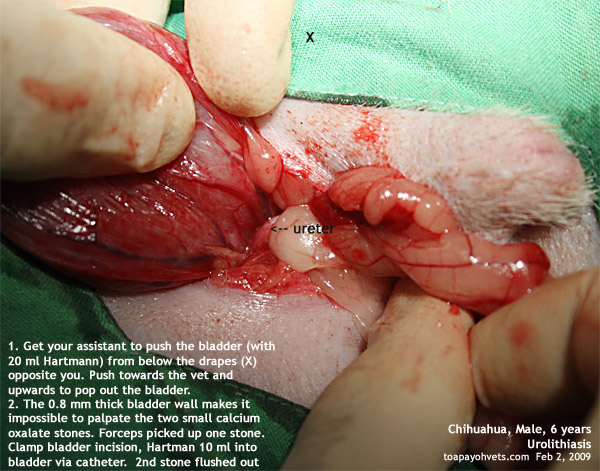
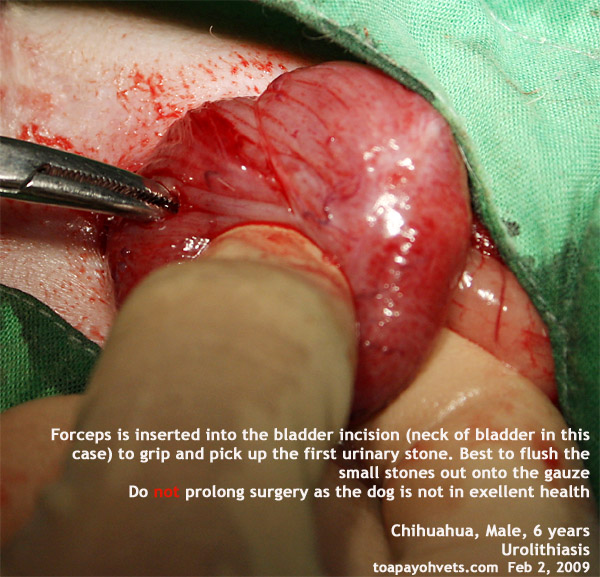
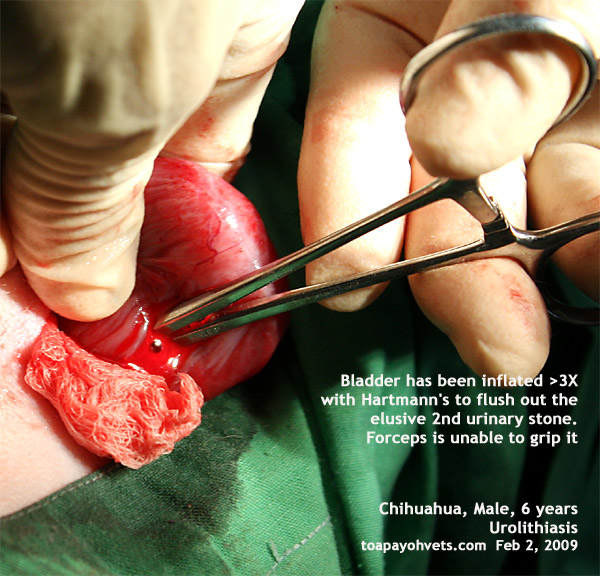
8. Surgery. In this case, 2 stones
were seen on the X-ray. It was extremely
difficult to pick up the 2nd stone as both
stones were around 0.5 mm in diameter and
the bladder incision had to be as small as
possible. A big bladder incision would not
be good for the dog.
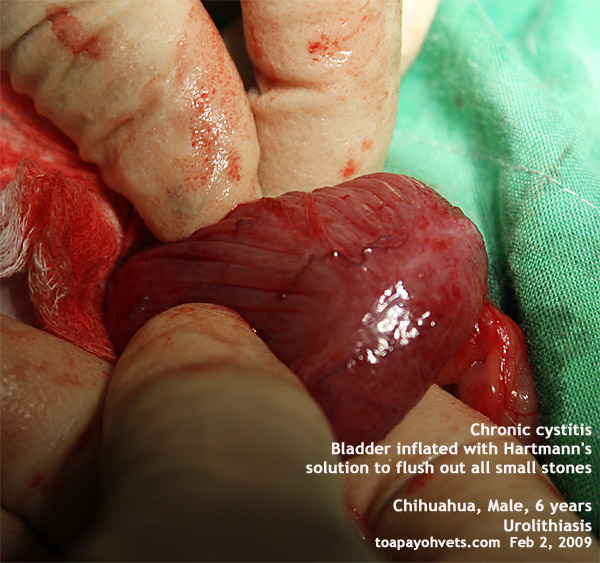
Extremely thickened bladder wall indicated
that the bladder had been infected by
bacteria for several years.
The infection had caused the bladder to
thicken and thicken its wall to fight
against the bacteria. It was a losing battle
and therefore the bladder became severely
reddened and swollen.
The mum was not aware of the need to get the
dog examined when she had to wash the
bathroom floor so many times a day - a
change of the dog's behaviour.
In retrospect, her complaint of having to
flush the toilet floor many times recently
would be a clue to the urinary tract
infection. Mum used to clean the floor once
a day previously. Mum's complaints "Must
clean the floor many times. The dog did not
urinate in a big amount." Therefore
frequency increased while urine volume
decreased per occasion.
 |
 |
 |
 |
9.
Post Surgery. Today is Mar 4, 2009.
Surgery was on Jan 30, 2009. The owner was
now satisfied and pleased that the dog's
first urination in the morning when brought
outdoors was a big volume, as in the past.
"There is a very small wound which seems not
to heal," the owner commented. It was
difficult to know what he was saying as he
did not bring the dog in for consultation.
Overall, he was happy so far as his best
friend was living a normal pain-free life
now - not having intense pain when passing
urine and therefore taking a very long time
to pee. Now, the dog just urinate one large
volume at one go and get on with enjoying
his outdoor exercise and urine-marking (with
little or no urine to mark).
As at Mar 4, 2009.
Home-cooked food. Dog drank normally and not
a lot as in the lst 4 days home.
Urine-marking downstairs where other dogs
had been. However little urine production or
none at times. I said, "The dog may start to
leave more urine inside his bladder in time
to come. Then stones might form again."
I asked the owner to monitor the urine
intake, colour and consistency over 24
hours. The dog was banned from the bedroom
because he would "pee" onto the mattress
which had to be thrown away. Doors would be
locked. He would pee at the kitchen drainage
grate but the owner would always bring him
outdoors in the morning so that he could pee
all urine at one go within the first time.
He continued to urine-mark with little urine
as this is the natural behaviour of male
dogs that have not been neutered. The dog
has to pee on the spots to over-ride the
smell of other dogs - to mark his territory.
Conclusion
X-rays are necessary before surgery in
this case so as to know how many urinary
stones are present in the bladder.
Calcium oxalate crystals are radio-dense
and will be easily spotted on X-rays. Due to
financial considerations, no X-rays were
done after surgery although this is
recommended. Two stones were shown to the
owner as evidence. It is best to produce
evidence to educate the owner.
Urinalysis is also necessary. There is no
guarantee that urinary stones will not
be formed again. Unlike struvite (triple
phosphate) urinary stones which form in
the presence of alkaline urine and
bacteria, calcium oxalate crystallisation is
not related to the alkalinity of urine
and therefore acidification of the urine in
this case is not advised. If you review the
blood test report, the dog's urine was
acidic actually.
Will the special Hills' urinary stone
prescription diet to prevent calcium
oxalate crystallisation work? One veterinary
book doubts this will help.
The owner feeds home-cooked food, so the
answer in this case will not be known for
some time. For other dog owners, it is
advised that you get your dog examined by
your vet at the first sign of difficulty in
peeing as it is much more inexpensive to get
early treatment than surgery and
hospitalisation.
 As at
Aug 31, 2010. No complaint from
the owner. This case may be one to "justify"
neutering of the male dog to prevent urinary
stasis and stone formation at an older age. As at
Aug 31, 2010. No complaint from
the owner. This case may be one to "justify"
neutering of the male dog to prevent urinary
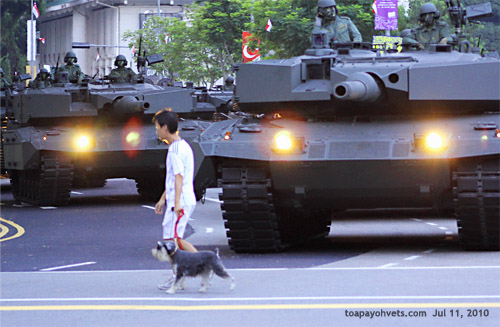
stasis and stone formation at an older age.This male dog needs to urine-mark his territory. He tries to retain some urine to urine-mark. Retention of urine causes crystallisation and bacterial infections of the bladder wall over the passage of time. Urinary stones form. Urine flow gets obstructed when they get stuck in the urethra. The dog can't pee normally and to some owners, it is costly to consult the veterinarian and get treatment for the dog in pain. It is hard for the dog owner to envisage the sequences of physiological events. Therefore advices to neuter this dog fall on deaf ears. I hope for the best for this dog. He would definitely be well cared for and much loved by the brother. If his health is good, he should live to a ripe old age of 15 years. |
Updates
will be at this webpage:
bekindtopets.com/animals/20090305Calcium_Oxalate_
Urinary_Stones_Chihuahua_ToaPayohVets.htm
Case 2 in 2014. Kidney stones
|
 |
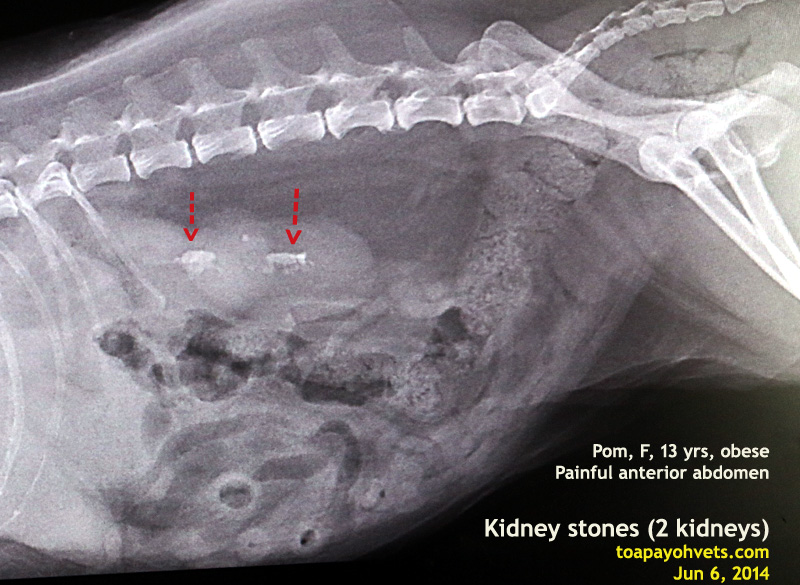 |
| Kidney stones (2 kidneys) | Kidney stones (2 kidneys) |
Blog:
http://2010vets.blogspot.sg/2014/06/1376-13-year-old-poodle-has-kidney.html
 See
interesting cases in male dogs at:
See
interesting cases in male dogs at:
Toxaemia
and anaemia in a young male Shih
Tzu. What to do?
More
info at:
Dogs or
Cats
To make an appointment:
e-mail
judy@toapayohvets.com
tel: +65 9668-6469, 6254-3326